
13

Q1. The base/fundamental unit of time is

  • minutes
  • second
  • hour
  • year
Q2. The meter that measures the distance moved by the vehicle is known as

  • odometer
  • speedometer
  • thermometer
  • none of the above
Q3. Which part of a second is called nano second?

  • One hundredth
  • One thousandth
  • One millionth
  • One billionth
Q4. Which of the following is not an example of to and fro motion?

  • Motion of a simple pendulum
  • Motion of a liquid in U-tube
  • Motion of a swing
  • Motion of earth around the sun
Q5. Which of the following is not used for measuring time?

  • Sundial
  • Water clock
  • Sand clock
  • Hand span
Q6. A bus moves with a speed of 40 km/h and covers a distance of 10 km. What is the total time taken by the bus during the whole journey?

  • 1/2 hour
  • 2/3 hour
  • 1/4 hour
  • 1 hour
Q7. Who found that a pendulum of a given length takes always the same time to complete one oscillation?

  • Galileo Galilie
  • Newton
  • Albert Einstein
  • Archimedes
Q8. How many seconds are there in one day?

  • 86000 seconds
  • 86400 seconds
  • 36000 seconds
  • 90000 seconds
Q9. How many second make 3 minutes?

  • 150 seconds
  • 120 seconds
  • 180 seconds
  • 300 seconds
Q10. If the distance-time graph is a straight line parallel to time axis, it indicates that the object is

  • not moving
  • moving
  • moving with an increasing speed
  • moving with a decreasing speed
Q11. The  clocks or watches which have an electric circuit with one or more cells are called

  • quartz clocks
  • sundial
  • water clocks
  • sand clocks
Q12. Which of these is not a unit of speed?

  • metre/second
  • kilometre/hour
  •  second/metre
  • metre/hour
Q13. An object is said to have a uniform motion if it moves

  • In one way only along a straight line path
  • At a constant speed in one way only, along a straight line path.
  • At a constant speed
  • Uniformly along a circular path.
Q14. Which out of the following is the biggest unit of measuring time?

  • Second
  • Year
  • Day
  • Hour
Q15. Rate of distance travelled with time is termed as :

  •  Speed
  • Velocity
  • Acceleration
  • Displacement
Q16. The speed of an object is defined as

  • The distance traveled by the object multiplied by the time taken
  • The distance traveled by the object
  • The time taken
  • The distance traveled by the object divide by the time taken
Q17. To measure time, we can use

  • Only the regularity of the oscillations of a quartz crystal.
  • Only the regularity of the earth's rotation about its own axis.
  • Only the periodic oscillation of a pendulum.
  • All of the above.
Q18. The to and fro motion of a simple pendulum is an example of a

  • Linear motion
  • Circular motion
  • Oscillatory motion
  • All of the above
Q19. Average speed = _______

  • Half distance travelled / time
  •  Half distance travelled x time
  •  Total distance travelled / total time
  • Total distance travelled x total time
Q20. A pendulum takes 10 sec to complete 5 oscillations. What is the time period of the pendulum?

  • 1 seconds
  • 2 seconds
  • 1.5 seconds
  • 2.5 seconds
Q21. Time taken by a pendulum to complete one oscillation is known as

  • Time interval
  • Time period
  • Time gap
  • Pendulum time
Q22. A bike moves with a speed of 50 km/h for 30 minutes and then with a speed of 60 km/h for the next 30 minutes. The total distance covered by the bike is

  • 40 km
  • 55 km
  • 45 km
  • 50 km
Q23. On which axis, dependent variables are represented?

  • x-axis
  • y-axis
  • at origin
  • none of the above
Q24. When the bob of the pendulum is released after taking it slightly to one side, it:

  • becomes still and does not move
  • begins to move to and fro
  • comes to rest at the mean position
  • begins to move up and down.
Q25. A car moves with a speed of 40 km/h for 15 minutes and then with a speed of 60 km/h for the next 15 minutes. The total distance covered by the car is:
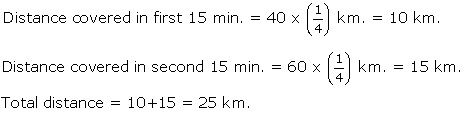
  • 100 km
  • 25 km
  • 15 km
  • 10 km
Q26. Which of the following relations is correct?

  • Speed = Distance x Time
  • Speed = Distance / Time
  • Speed = Time/ Distance
  • Speed = 1/Distance x Time
Q27. If the speed of an object moving along a straight line keeps changing, its motion is said to be

  • uniform motion
  • non-uniform motion
  • circular motion
  • periodic motion
Q28. Which speed do we take into consideration while measuring time taken to cover a particular distance?

  • Average speed
  • Initial speed
  • Final speed
  • Sum of initial and final speed
Q29. The ages of stars and planet are often expressed in:

  • millions of years
  • billions of years
  • hundreds of years
  • thousands of years
Q30. Time period of a simple pendulum depends upon:

  • None of the above
  • Both of the above
  • Weight of bob
  • Length of the pendulum
Q31. 1 hour is equal to how many seconds?

  • 360 seconds
  • 3600 seconds
  • 36000 seconds
  • 720 seconds
Q32. Which of the following is the S.I. unit of time?

  • Hour
  • Minute
  • Day
  • Second
Q33. Which one of the following is written at one corner of speedometer?

  •  km/h
  • km h
  • m s
  • s/m
Q34. Out of the animals - horse, hound, tortoise and cat - the fastest and the slowest are

  • horse and tortoise, respectively
  •  horse and cat, respectively
  • hound and cat, respectively.
  • hound and tortoise, respectively
Q35. Which of the following statements is correct about distance-time graphs?

  • We can find the distance moved by a body at any instant of time
  • The graph shows that motion is uniform or non-uniform
  • The graph tells that motion is accelerated or retarded
  • All of the above
Q36. The time between one new moon to the next is called?

  • A day
  • A week
  • A month
  • A year
Q37. 1 hour 30 minutes is equal to how many seconds?

  • 360 seconds
  • 3600 seconds
  • 5400 seconds
  • 720 seconds
Q38. One of the most well-known periodic motions is that

  • of sea waves
  • of a car
  • of a simple pendulum
  • all of the above
Q39. The distance-time graph is an example of ________ graph.

  • bar
  • pie
  • line
  • none of the above
Q40. A bus moves with a speed of 40 km/h and covers a distance of 20 km. What is the total time taken by the bus during the whole journey?

  •  1/2 hour
  • 2/3 hour
  • 1/4 hour
  • 1 hour

Comments

Popular posts from this blog

16

Q1. Which of the following does not deplete the water table at a place? Increasing number of tube-wells Increasing deforestation Scanty rainfall Increasing snowfall Solution Increasing snowfall does not deplete the water table at a place. Q2. The process in which rainwater seeps through the soil is called  Distillation Infiltration Recharging Harvesting Solution When the rain falls on the Earth's surface, some of the water seeps through the soil. This proce...

17

Q1. Forests are useful to us in many ways. However, man has also faced some undesirable consequences due to forests. Which of the following is one of them? Prevention of floods Prevention of soil erosion Maintenance of water table Forest fires Solution Forest fires are the most common hazards in the forests. They pose a threat not only to the forest wealth but also to the entire flora and fauna disturbing the biodiversity and the ecology and environment of a region.  Q2. What prevents sunlight from entering forests? Covering of leaves ...

15

Q1. What kind of image is formed by a plane mirror? Real and inverted Real and erect Virtual and erect Virtual and inverted Solution Virtual and erect image is formed by a plane mirror. Q2. The speed of light in vacuum is 3 x 10 6 m/s 3 x 10 7 m/s 3 x 10 8 m/s 3 x 10 9 m/s Solution The speed of light in vacuum is 3 x 10 8 m/s. Q3. Dispersion of light by a glass prism takes place because: ...